

Every child deserves the opportunity to experience the freedom, challenge, creativity and enjoyment that outdoor play can provide. For children with special educational needs and disabilities (SEND), a thoughtfully designed outdoor environment can be particularly powerful.
At Playgarden, we believe that an outdoor space should do more than simply provide accessible equipment. It should create opportunities for children to move, explore, communicate, regulate, take appropriate risks, develop independence and, most importantly, enjoy being outside.
For anyone considering the development of a specialist or inclusive outdoor play area, the starting point should not be “What equipment should we buy?” but rather: “What do our children need from their outdoor environment?”
This change in approach can make a significant difference to the quality and long-term value of the finished space.


What makes a good SEND outdoor environment?
There is no single design that will meet the needs of every child with SEND. Children have different abilities, preferences, sensory needs and levels of confidence. One child may seek movement, climbing and physical challenge, while another may become overwhelmed by noise, busy spaces or unpredictable movement. Some children may need opportunities to retreat and regulate, while others may benefit from spaces that encourage interaction and communication. This is why inclusive play is not about making every piece of equipment accessible to every child. It is about creating a diverse range of opportunities so that every child can find meaningful ways to participate.
A successful outdoor environment might include opportunities for:
- Physical and active play
- Climbing, balancing and movement
- Sensory exploration
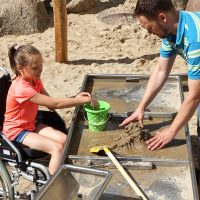
- Water and sand play
- Creative and imaginative play
- Social interaction
- Independent play
- Quiet reflection and regulation
- Challenge and appropriate risk-taking
- Nature-based learning
The aim is to create an environment where children can make choices about how, where and at what level they want to play.


What should a school or educational setting consider before starting a project?
Developing a successful SEND outdoor area requires more than choosing products and obtaining quotations. A considered process is much more likely to result in an environment that genuinely meets the needs of the children.
A. Understand your children’s needs
Work with your SENCO, teaching staff, therapists, parents and children where appropriate to identify the barriers and opportunities within your current outdoor provision.
B. Audit your existing space
Look carefully at what you already have. Consider access, surfacing, boundaries, planting, drainage, shade, shelter, storage, supervision and existing play opportunities. You may already have valuable features that can be retained and enhanced.
C. Establish your priorities
Not every school has the budget to deliver everything at once. Identify the improvements that will make the greatest difference to your children and develop a clear hierarchy of priorities.
D. Develop a design around needs
The design should bring together physical, sensory, social, emotional and educational requirements. Think about the whole landscape, rather than simply positioning individual pieces of play equipment.
E. Consider the long term
A successful outdoor environment needs to remain useful, safe and attractive for many years. Consider maintenance, planting, surfacing, equipment, drainage, storage and future changes in the school’s pupil population.
F. Involve staff in the finished environment
The value of the space will depend partly on how confidently staff use it. Consider how the outdoor environment can be incorporated into everyday teaching, playtimes and individual support strategies.
G. The most important question
When developing an outdoor environment for children with SEND, it is easy to focus on accessibility, safety and equipment. These things are important. But the most important question is ultimately much simpler:
Will children want to use this space?
An outdoor environment should be exciting, stimulating, beautiful and playful. It should encourage children to explore, make choices, take appropriate risks and develop at their own pace. It should not look or feel like a clinical environment. It should feel like a wonderful place to be.


At Playgarden, we take a consultative approach to developing inclusive outdoor environments. We work with schools to understand their children, staff, existing spaces and priorities before developing a design that brings these elements together. Our aim is not simply to make a playground accessible.
It is to create an outdoor environment where every child can find their own way to play.
To request your free Guide to Designing SEND Outdoor Areas, contact Playgarden on 0114 2821285 or info@playgardens.co.uk